


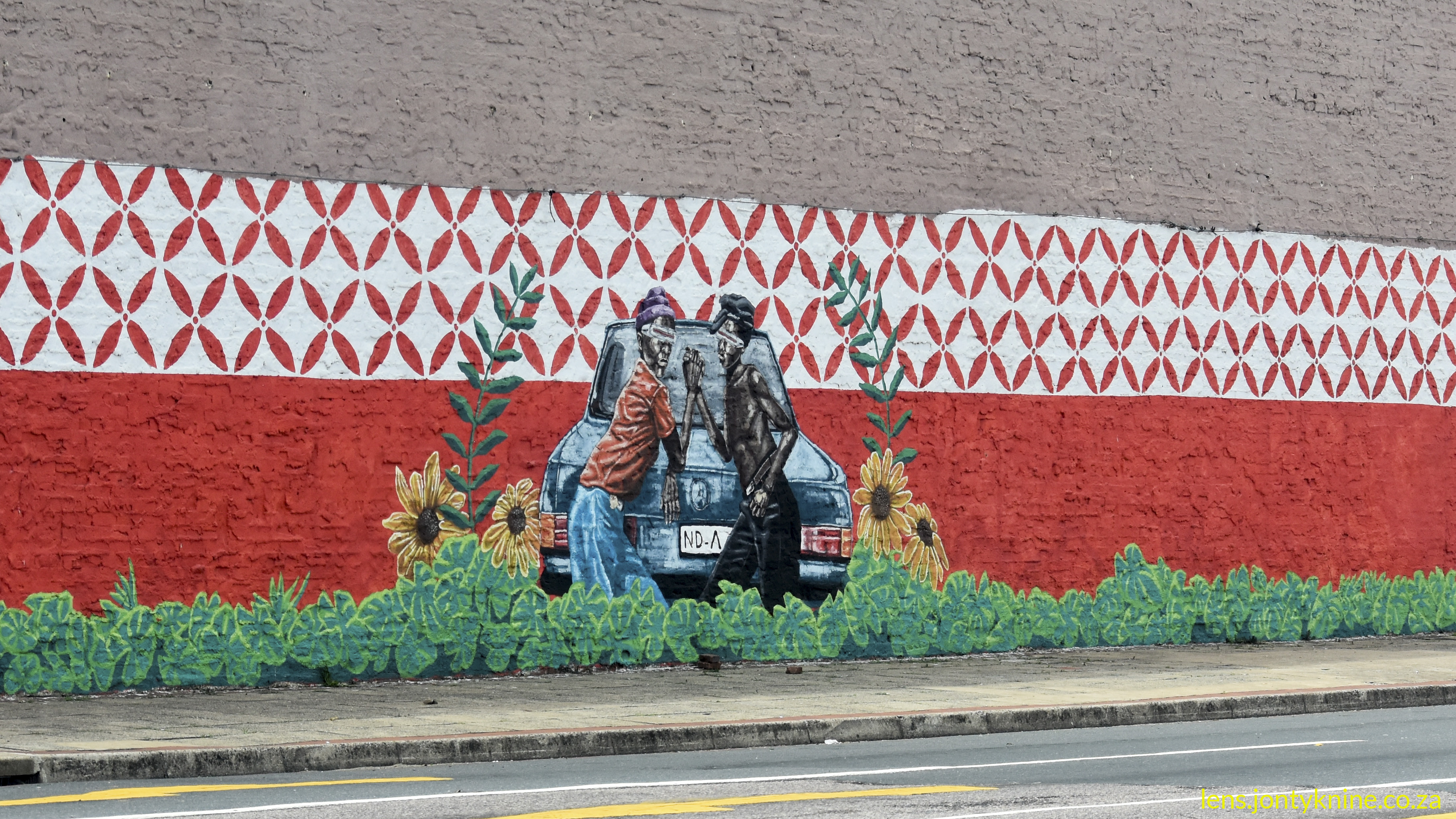
The mural is structured in horizontal bands:
- The upper section of the wall is a plain, muted grayish-beige.
- A broad horizontal band features a repeating red geometric pattern on white (interlocking pointed ovals or petal-like forms that create a rhythmic, almost textile or traditional motif effect).
- The lower main field is a solid, saturated red brick-red wall.
Centered in the red field is a rear three-quarter view of a blue classic car (appearing to be a late-1970s/1980s-style hatchback or sedan, possibly a Volkswagen or similar European model popular in South Africa). The license plate reads “ND-A”. In older South African (specifically KwaZulu-Natal) registration systems, “ND” was the code associated with Durban, so the plate strongly suggests a local Durban/KZN connection—either as a realistic detail, a personalised plate, or a deliberate regional marker.
Two figures stand in front of / interacting with the car:
- The figure on the left wears an orange/rust-colored short-sleeved top, blue trousers, and a purple head covering or styled hair. They lean slightly toward the other person.
- The figure on the right is shirtless, wearing dark trousers, with darker skin tone and hair styled up. Both appear to be engaged in a high-five, handshake, or close greeting gesture, with white facial markings or paint around the eyes/forehead area (which could reference traditional body paint, contemporary fashion, or artistic stylization).
Flanking the car and figures are tall green leafy stems and bright yellow sunflowers (with dark centers), rising from a continuous band of lush green foliage and bushes painted along the base of the wall. The greenery grounds the scene and softens the hard red surface, creating a sense of the figures standing in or emerging from a garden-like space even while the setting is clearly urban (sidewalk, road, curb visible).
Style, Mood, and Possible Interpretations
The style is realistic-figurative mural work with bold, flat color fields and strong outlines typical of contemporary South African street art. The red wall provides dramatic contrast that makes the blue car, yellow flowers, and human figures pop. The patterned upper band adds a decorative, almost architectural or textile layer that elevates the piece beyond pure realism—it feels intentional and culturally resonant rather than purely decorative.
The overall mood is warm, affirmative, and communal. The central interaction (the greeting/high-five) conveys connection, camaraderie, or recognition. Combined with the everyday object of the car and the cheerful sunflowers, the mural can be read as a celebration of ordinary urban life, friendship, or local identity in a South African (likely Durban-area) context. Sunflowers often symbolize positivity, loyalty, or resilience; here they frame the human moment and softenthe industrial/urban setting.
The “ND-A” plate is a particularly localizing detail. Given the current time zone (SAST) and the historical ND = Durban coding, this almost certainly places the mural in or references KwaZulu-Natal. The white facial markings add an extra layer—possibly alluding to traditional practices, performance, or simply a stylistic choice that gives the figures a slightly ritualized or heightened presence.
Context and Presentation
The photograph is taken at street level on a sunny day, showing the mural as it exists in public space: weathered brick texture visible through the paint in places, curb and road markings in the foreground, and the sense that this is everyday public art meant to be encountered by passers-by and motorists. Small objects (possibly debris or markers) sit on the pavement near the base.
Without additional context from the photographer or artist credits, it is difficult to identify the exact creator or commission (searches for the distinctive combination of elements—blue car with ND-A plate, two interacting figures, sunflowers, red wall with that specific patterned band—did not turn up a widely documented match). It fits comfortably within the broader landscape of contemporary Durban/KZN street art, which often blends figurative realism, local cultural references, bright color, and public-space storytelling.