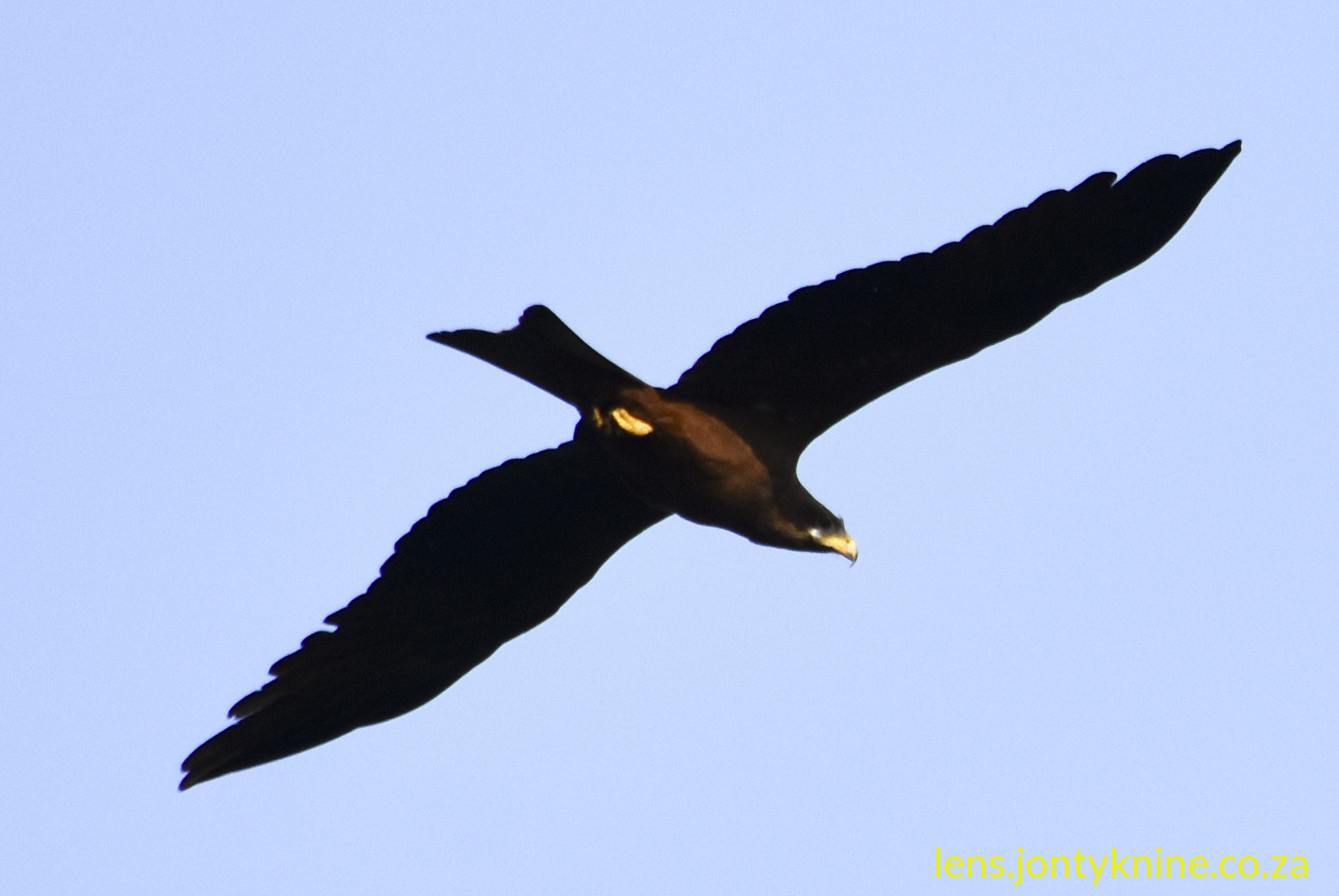





This is a medium-sized African bird of prey (raptor) in the Accipitridae family, closely related to (and sometimes still treated as a subspecies of) the Black Kite (Milvus migrans). It is the Afrotropical counterpart of the Black Kite and is widespread across much of sub-Saharan Africa (including Madagascar and the Comoros), with some presence into Egypt, southwestern Arabia, and the Horn of Africa. Given the photo’s context (and the SAST timezone), this fits the common southern/eastern African form (M. a. parasitus).
Key identification features matching the photo
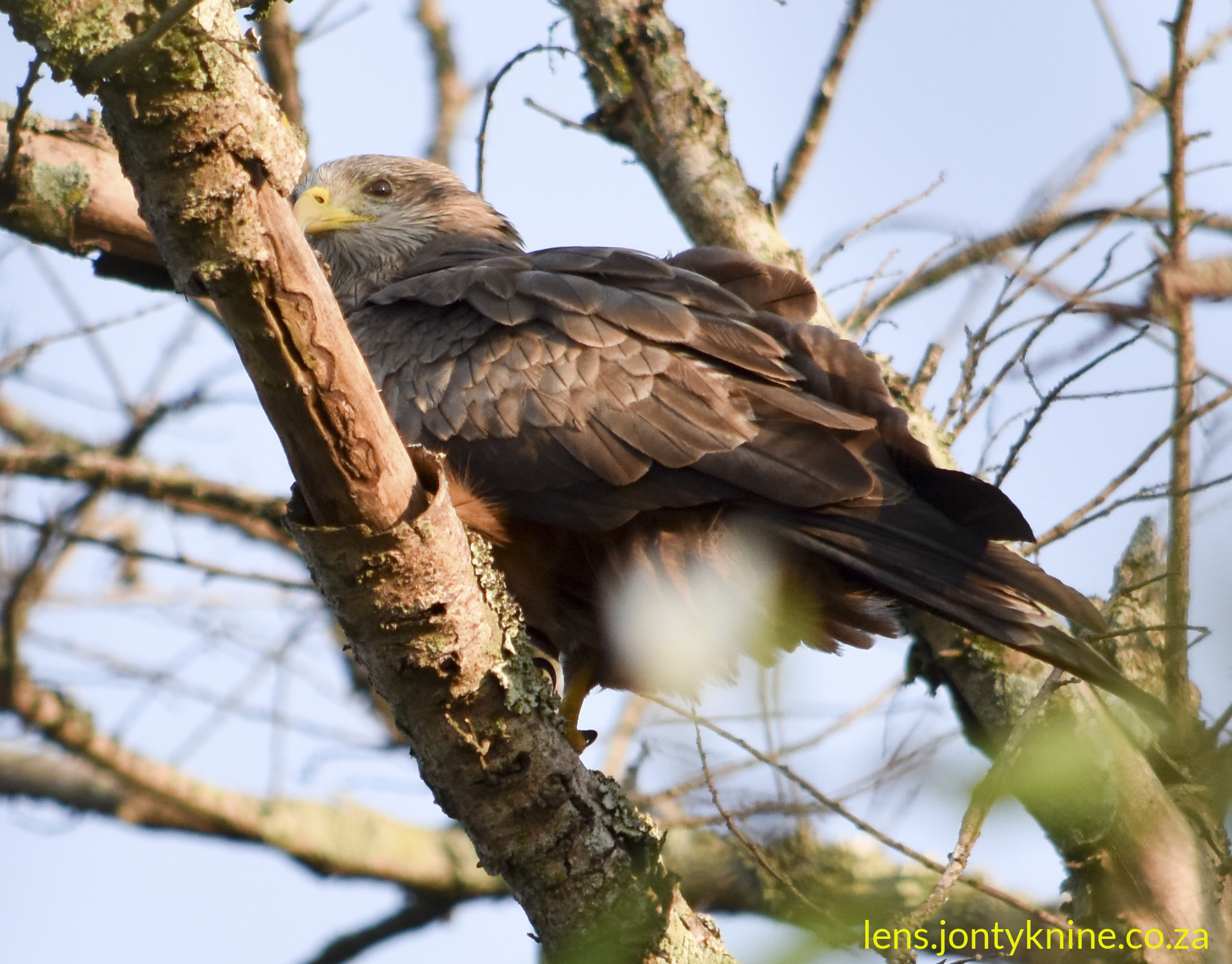
- Bright yellow bill (entirely yellow in adults—the most diagnostic field mark that separates it from the Black Kite, which has a black bill with yellow cere). The hooked shape is typical of raptors.
- Greyish head (paler than the body, often fairly uniform or only lightly streaked in adults).
- Dark brown to rufous-brown plumage overall, with the wings and back appearing rich brown; underparts can show warmer/rufous tones (visible on the lower body here). The plumage is relatively plain/uniform compared with many other raptors.
- Yellow legs and feet (partially visible).
- Structure: Medium size (roughly 47–55 cm / 18–22 in long, wingspan ~1.2–1.5 m), relatively long wings and a shallowly forked tail (not fully visible here as the bird is perched and folded). It has a typical kite silhouette—buoyant flight when soaring, often with a distinctive tilting or twisting of the tail.
- Dark eye (iris remains darker than in some adult Black Kites).
Juveniles look similar but have darker (blackish) bills that gradually turn yellow over the first couple of years, more mottled plumage, and can be harder to separate from juvenile Black Kites where the two overlap in winter. The clean yellow bill and overall look here indicate an adult.
Context, behaviour, and similar species
Yellow-billed Kites are highly opportunistic and adaptable. They occur in a wide range of open and semi-open habitats—savanna, woodland, farmland, rivers, and even suburban parks or near human settlements—where they often scavenge at rubbish dumps, markets, or roadsides, or take insects (especially termites), small vertebrates, fish, and carrion. They are frequently gregarious and can be seen soaring or perched conspicuously on trees or posts. In southern Africa they are largely intra-African migrants (present mainly in the austral summer).
Similar species notes:
- Black Kite (Milvus migrans): Overlaps as a Palearctic migrant in parts of Africa. Adults have a black bill (yellow only at the cere), often a paler/more streaked head, and subtle plumage differences; juveniles of the two can be very similar.
- Other African raptors (e.g., various buzzards, goshawks, or the African Harrier-Hawk) differ in bill colour, head patterning, underpart barring/streaking, tail shape, or overall proportions. The combination of the all-yellow bill + grey head + uniform brownish body is distinctive for an adult Yellow-billed Kite.
This is a common and familiar bird across much of its range—often one of the first raptors people notice when birding in Africa due to its bold yellow bill and frequent association with people. Great photo of a classic adult!