





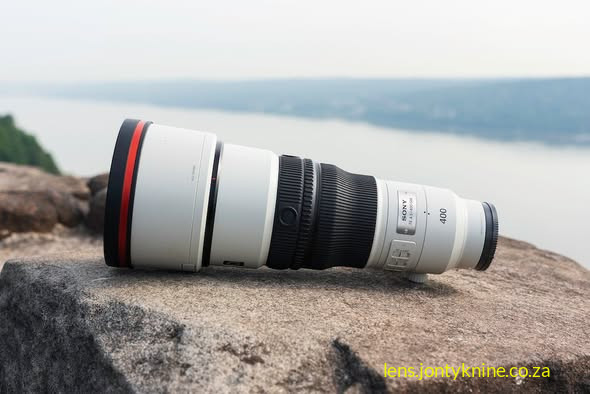
The announcement came on September 15, 2026, positioning both as the world’s lightest lenses in their respective classes and targeting wildlife, sports, birding, and other handheld long-reach applications.
These fill a notable gap in Sony’s lineup. Sony already offered fast (and heavy/expensive) flagships like the FE 400mm f/2.8 GM OSS (~2,895 g) and FE 600mm f/4 GM OSS (~3,040 g). The new pair prioritizes extreme portability and accessibility while retaining G Master optical and autofocus performance. Early hands-on coverage and reviews describe them as remarkably similar in size, handling, and design—so much so that users can easily mix them up.
Key Specifications and Shared Features
Both lenses share a nearly identical physical design philosophy:
| Feature | FE 400mm f/4.5 GM OSS | FE 600mm f/6.3 GM OSS |
|---|---|---|
| Weight (excl. tripod foot) | 994 g | 995 g |
| Dimensions | 108 × 242 mm | 108 × 263 mm |
| Filter thread | 95 mm | 95 mm |
| Minimum focus | 2.5 m | 2.5 m |
| Max magnification | 0.18× | 0.25× |
| Optical design | 22 elements / 16 groups (3 Super ED + 1 ED) | 24 elements / 17 groups (3 Super ED + 1 ED) |
| Aperture | f/4.5–f/32, 11-blade circular | f/6.3–f/32, 11-blade circular |
| Price (MSRP USD) | $2,699.99 | $3,699.99 |
| Availability | Pre-order now; shipping October 2026 | Pre-order now; shipping October 2026 |
Additional shared traits include:
- Autofocus: Dual XD (extreme dynamic) Linear Motors (one per focus group) for fast, precise, quiet performance. Compatible with high-speed continuous shooting and tracking up to 120 fps (stills or 4K 120p video) on capable bodies such as the α9 III or α1 II.
- Stabilization: Optical SteadyShot (OSS) with three modes that work with in-body image stabilization.
- Build and handling: Dust- and moisture-resistant construction, fluorine coating on the front element, removable tripod foot, four focus-hold buttons, customizable function ring, focus-range limiter, full-time Direct Manual Focus (DMF), and switches for AF/MF and stabilization modes. The center of gravity is shifted rearward (closer to the camera) for better balance during handheld panning and tracking.
- Teleconverter compatibility: Works with Sony’s 1.4× (SEL14TC) and 2× (SEL20TC) teleconverters. The 400mm becomes a 560mm f/6.3 or 800mm f/9; the 600mm becomes an 840mm f/9 or 1,200mm f/13.
- Other: Soft carrying case included; Nano AR Coating II for flare/ghosting control.
The optical formulas are closely related—the 600mm essentially adds a rear group for the extra magnification while keeping the same special-glass complement. Sony emphasizes high resolution and controlled aberrations across the frame, even wide open, plus smooth G Master bokeh.
Design Philosophy and Practical Implications
Sony engineered these for active, mobile shooting rather than pure studio or tripod work. At under 1 kg each (roughly 2.2 lb), they are dramatically lighter than traditional pro primes and competitive with (or lighter than) popular alternatives:
- Nikon Z 400mm f/4.5 VR S (~1,160 g)
- Nikon Z 600mm f/6.3 VR S (~1,390 g)
- Sigma 500mm f/5.6 DG DN OS Sports (~1,365 g)
The near-identical size and weight make the pair highly interchangeable in a kit. Photographers can carry both more easily than a single traditional 600mm f/4. The rearward balance improves handheld tracking of birds in flight, athletes, or wildlife, and reduces fatigue on long outings. Close-focusing capability (2.5 m) is useful for closer subjects or environmental portraits, with the 600mm delivering stronger magnification.
Trade-offs are primarily optical speed. The f/4.5 and f/6.3 apertures gather less light than the faster GM primes, so higher ISO or careful exposure management may be needed in low light. Early reviews note the aperture can feel limiting in dim conditions but praise the overall sharpness, autofocus reliability, and handling for the intended use cases.
Market Context and Who These Lenses Suit
These lenses directly address demand for portable super-telephoto options that previously favored Nikon’s lightweight Z-mount primes. They sit between Sony’s versatile zooms (e.g., 200-600mm G OSS or 100-400mm GM) and the ultra-premium fast primes, offering prime-level optical quality and AF performance at a more approachable (though still premium) price point—especially the 400mm.
Ideal users include wildlife and bird photographers who hike or travel, sports shooters who need mobility, and hybrid stills/video creators who value quiet AF and high-speed tracking. They pair particularly well with high-resolution or high-speed Sony bodies. For those needing maximum light-gathering or the absolute shallowest depth of field, the existing f/2.8 and f/4 GMs remain preferable (at much higher weight and cost).
Pre-orders opened around the announcement date, with shipping expected in October 2026. Official Sony pages and major retailers list the products with the specifications above. Early hands-on impressions from outlets such as DPReview, PetaPixel, and Amateur Photographer consistently highlight the surprising lightness and handling as the standout achievements.