





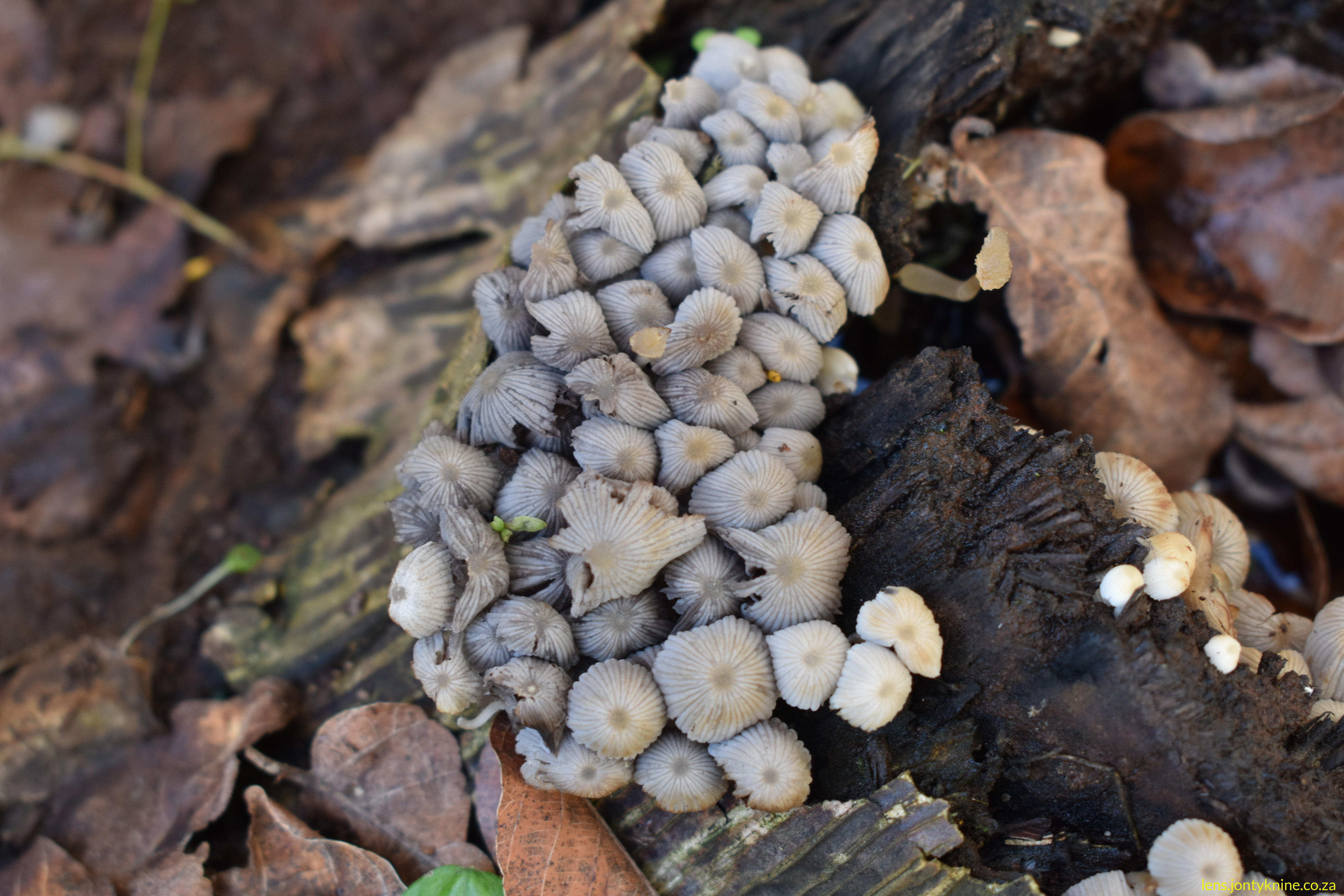
Coprinellus disseminatus (commonly called Fairy Inkcap, Fairy Bonnet, Trooping Crumble Cap, or Non-inky Coprinus).
This is a classic example of a dense troop of these tiny, delicate mushrooms growing on decaying wood. Your photo shows the typical dense clustering on a rotting log or stump amid leaf litter, with small (usually 0.5–2 cm / ~¼–¾ inch) pale gray to grayish-beige or buff caps that are strongly radially pleated/grooved (striate) from the margin nearly to the center. The caps start more oval or egg-shaped when young and expand to bell-shaped or broadly convex; some in the cluster appear slightly more open or creamier toward the edges, which is normal variation with age and moisture. The stems are thin, white, fragile, and hollow.
Key identifying features that match
- Growth habit: Extremely gregarious—often in large, dense swarms of dozens to hundreds (or thousands) on or near rotting hardwood stumps, logs, buried wood, or woody debris. Individual mushrooms are separate (not sharing a fused base like some other clustered species).
- Cap: Thin, fragile, strongly pleated/ribbed, pale when young (whitish, cream, or pale buff with a browner center), becoming grayish to gray-brown. The surface can look finely textured or nearly smooth when mature.
- Gills: Start whitish, turn gray then blackish as spores mature, but (unlike many classic “inkcaps”) they do not fully deliquesce (dissolve into black ink). The whole fruiting body tends to dry out and crumble instead—hence “crumble cap.”
- Spore print: Black or blackish-brown (if you ever take one).
- Season and ecology: Saprobic (wood-decay) fungus, common in spring through fall (timing varies by region) after rain, widely distributed in North America, Europe, and elsewhere on decaying wood.
These features distinguish it well from bulkier clustered wood-growers (such as mica caps / Coprinellus micaceus, which are larger, more golden-brown, and often have shiny mica-like granules when young, plus stronger deliquescence) or various Mycena species (which are typically less densely packed in massive troops and have different microscopic details).
Additional notes
- Edibility: Generally regarded as non-toxic/edible in the sense that it is not poisonous, but it is far too small, fragile, and insubstantial to be worth collecting or eating. It does not keep well.
- Look-alikes and caveats: Closely related species in the same group (sometimes placed in Tulosesus or treated as cryptic species within the “fairy inkcap” complex) can look nearly identical, especially outside the classic European/North American range; definitive separation sometimes needs microscopy or DNA. Photo-based ID has limits (no spore print, microscopic features, exact substrate details, or smell available here), so this is a strong morphological and ecological match to the common C. disseminatus rather than a lab-confirmed determination.
- Ecological role: A decomposer that helps break down dead wood, recycling nutrients in forest ecosystems. The dense “fairy” troops are one of the more charming and photogenic woodland sights after wet weather.
If you have additional details (location/region, exact substrate, season, close-ups of gills or stems, or a spore print), that could refine the ID further. Never consume wild mushrooms based solely on a photo identification—local experts, field guides, or mycological societies are the safe route for any foraging.