






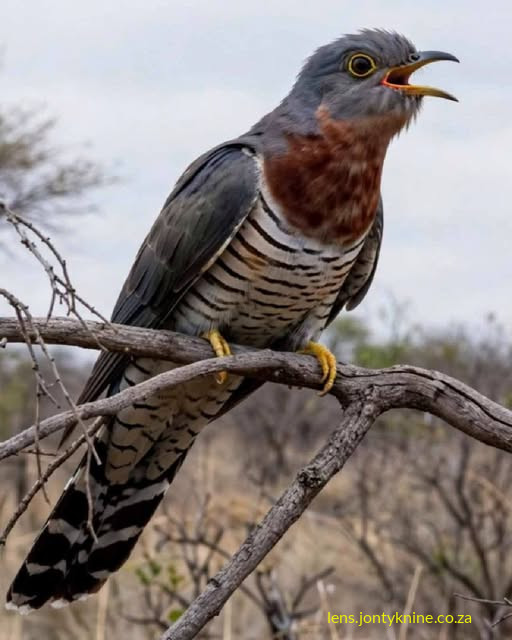
The “Piet-my-vrou” (also written Piet-my-vrou or Piet myn Vrouw) is the well-known Afrikaans name for the Red-chested Cuckoo (Cuculus solitarius) in South Africa.
Why the name?
The name is onomatopoeic — it comes directly from the male’s loud, distinctive three-note call, which sounds like “Piet-my-vrou” (or sometimes “quid-pro-quo”). In Afrikaans, “Piet my vrou” roughly means “Piet, my wife,” which is how the call has long been interpreted by Afrikaans speakers. The bird is far more often heard than seen, and its repetitive calling is one of the classic sounds of spring and summer in many parts of South Africa.
Identification and appearance
- Medium-sized cuckoo, about 28–31 cm long.
- Males: slate-grey upperparts, pale grey throat, distinctive broad rufous/cinnamon (russet) band across the upper breast, creamy or pale buff belly that is often barred, and a long dark grey tail with white tips.
- Females are similar but usually duller on the breast with more barring.
- Yellow eye-ring and yellow legs/feet are noticeable.
- In flight it can look somewhat hawk-like (pointed wings, long tail).
- Juveniles are more heavily barred and darker.
It is secretive and usually stays high in the canopy of trees, which is why most people only ever hear it.
Habitat, distribution and seasonality in South Africa
It is a common intra-African migrant and summer breeding visitor to southern Africa (arriving roughly September–October and departing around March–April). It prefers wooded habitats — forests, woodland, riverine thickets, well-wooded gardens, parks and plantations. It is widespread in the higher-rainfall eastern and northern parts of South Africa and also occurs on the wetter Highveld (including Gauteng), but is largely absent from the dry west.
Behaviour and ecology
- Brood parasite: It does not build its own nest. The female lays eggs in the nests of other birds (especially Cape Robin-Chat / Gewone Janfrederik, other robin-chats, thrushes, Cape Wagtail, etc.). The cuckoo chick usually ejects the host’s eggs or young and is raised by the foster parents. This is the same strategy used by many other cuckoos.
- Diet: Mainly insects, with a strong preference for hairy caterpillars (which many other birds avoid). It also takes other invertebrates and some small vertebrates or berries.
- Highly vocal, especially males, who call persistently (day and night, often after rain) to advertise territory and attract females. The female has a different, softer “pik-pik-pik” call.
Cultural note
In South Africa the first calling of the Piet-my-vrou is widely regarded as a herald of spring / the start of the rainy season. Its call is deeply familiar and nostalgic to many people.
In short: if you are hearing a loud, repetitive three-note whistle that sounds like “Piet-my-vrou” in a wooded or garden area in South Africa during the warmer months, that is almost certainly the Red-chested Cuckoo.