




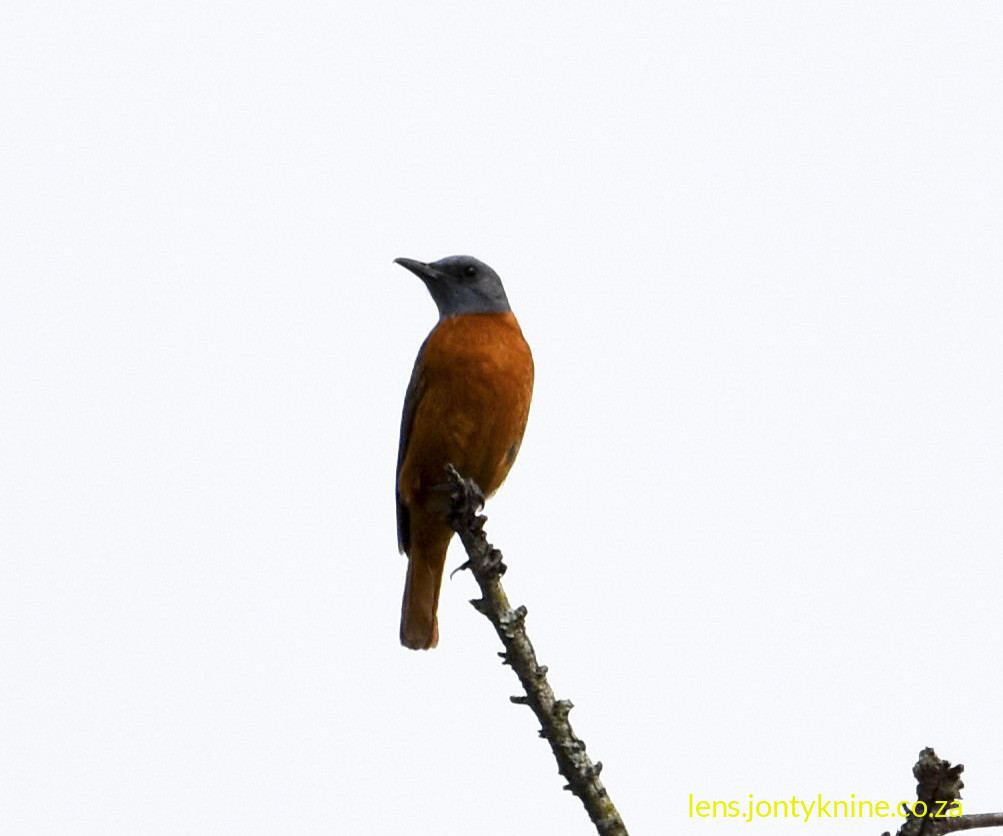
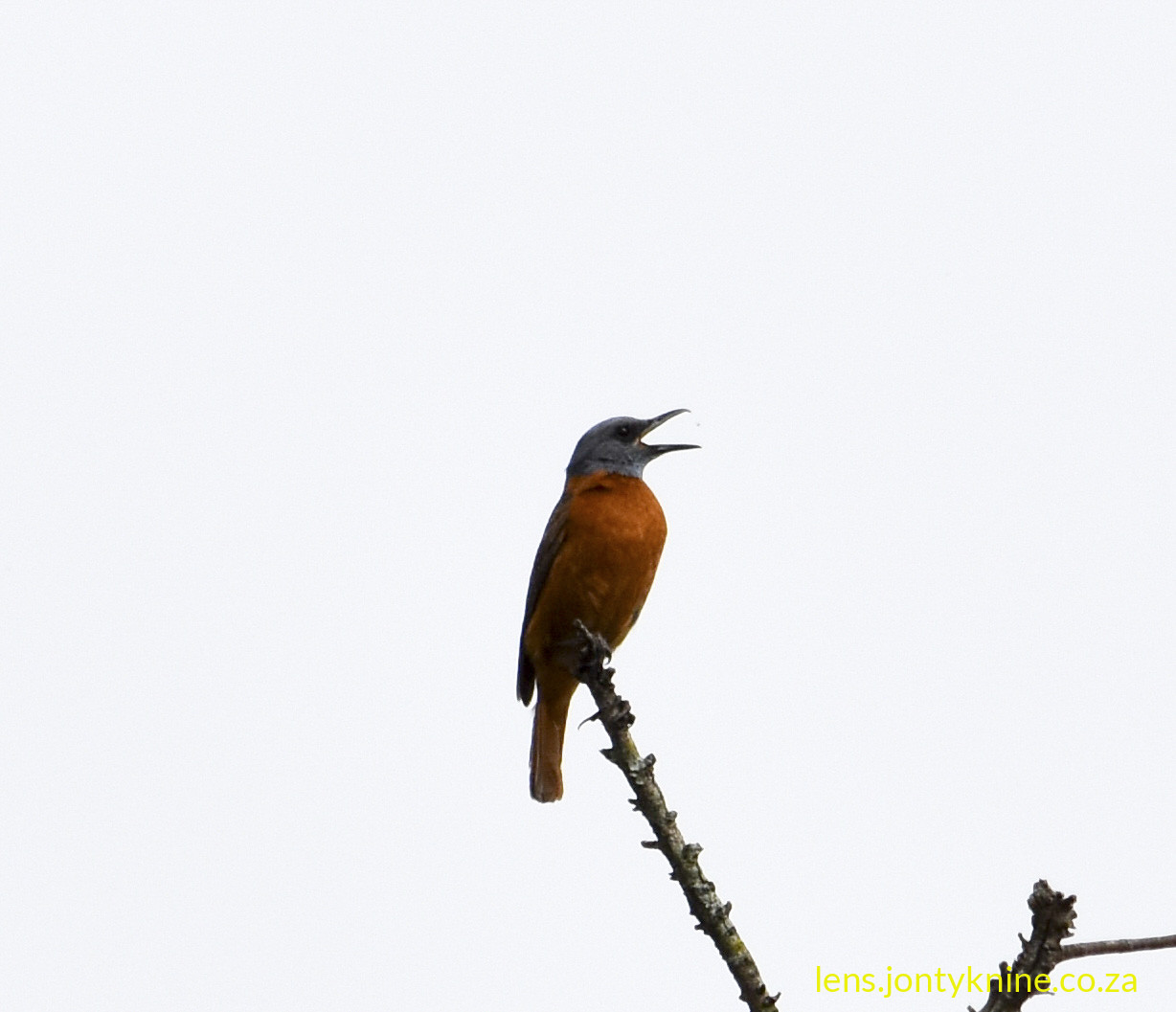
The bird in the photo shows the classic adult male plumage: a clean blue-gray (slate-gray) head and throat, contrasting sharply with rich orange-rufous (cinnamon-orange) underparts that extend onto the breast, belly, and undertail. The upperparts (back and wings) are duller brownish or gray-brown, the bill is dark and relatively slender, and the bird is perched upright on a thin dead branch with its bill open (likely calling or singing). The plain, bright background emphasizes the clean color blocks and compact, thrush-like shape.
Key identification features matching the photo
- Head and throat: Uniform blue-gray, without strong streaking or a white supercilium (this separates it from robin-chats).
- Underparts: Bright, unstreaked orange-rufous from the lower throat/upper breast downward.
- Upperparts: Brownish or gray-brown on the mantle, scapulars, and wings (not fully blue-gray like some other Monticola males).
- Size and structure: Medium-sized, robust, long-tailed rock thrush (typically 19–21 cm). The posture on an exposed perch is typical.
- Behavior cue: Open bill suggests territorial song or contact calls; males often sing from prominent perches.
Females of this species are much drabber (brown-headed with buffier, more mottled underparts and a small whitish throat patch) and would not match this individual. Juveniles are scaled and spotted.
Similar species and how to rule them out
- Cape Robin-Chat (Cossypha caffra): Orange underparts and grayish upperparts, but has a distinctive white eyebrow/supercilium, warmer brown upperparts, and a different face pattern. Not a uniform gray-headed bird.
- Other rock thrushes (e.g., Sentinel Rock Thrush Monticola explorator): Males often show more extensive blue-gray on the upperparts; the Cape Rock Thrush has the gray restricted mainly to the head/throat with browner back/wings. Distribution and habitat also differ.
- Robin-chats or other chats with orange breasts generally have stronger facial markings or different proportions.
Species background
The Cape Rock Thrush is a southern African endemic (mainly South Africa, Lesotho, Eswatini, and adjacent areas). It prefers rocky habitats—mountain slopes, cliffs, boulder-strewn grasslands, fynbos, and even adapted sites such as buildings or gardens near rocky ground. It is often seen singly or in pairs, foraging on the ground for insects, spiders, and small invertebrates, sometimes making short flights from perches. Males deliver a pleasant whistled song (often described with phrases like “tsee-tsee-tseet-chee-chweeeoo”) that can include mimicry, frequently from elevated perches at dawn or dusk.