



The frilled lizard (Chlamydosaurus kingii), also known as the frill-necked lizard or frilled dragon, is one of Australia’s most iconic and visually striking reptiles. It belongs to the family Agamidae (dragons) and is the sole species in its genus.
Physical Description and Adaptations
Adults typically reach 70–95 cm (about 2.3–3.1 feet) in total length, with the tail comprising roughly two-thirds of that. Males are larger and more robust than females; Australian individuals tend to be bigger than those from New Guinea. Weight ranges from about 0.4–1 kg (0.9–2.2 lbs).
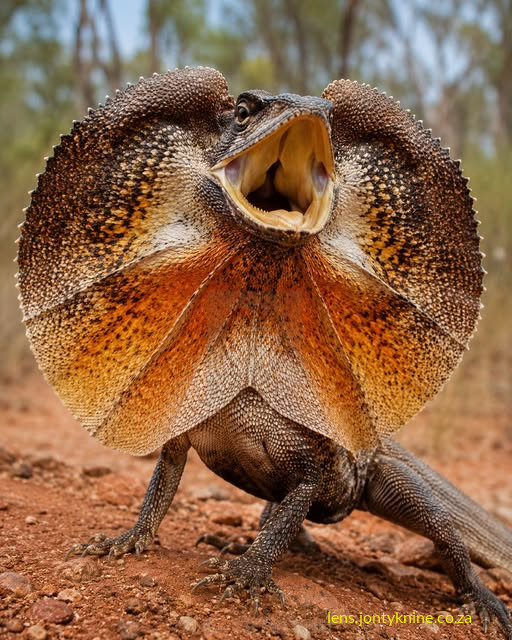
Their base coloration is generally grey, brown, orangish-brown, or black with mottled patterns for camouflage against tree bark and woodland floors. The standout feature is the large, pleated frill of skin around the neck, supported by elongated cartilaginous spines connected to the jawbones. When relaxed, it folds flat like a cape. When extended, it forms a dramatic, disc-shaped display up to 30 cm (12 inches) across, often revealing bright inner colors of red, orange, yellow, or white.
Key adaptations:
- Frill display: Primarily a bluffing defense to appear larger and more intimidating. It is accompanied by mouth gaping (revealing a yellow or pink interior), loud hissing, upright posture on hind legs, and sometimes tail lashing or jumping toward the threat.
- Bipedal running: They can sprint on hind legs with forelegs and tail raised, reaching speeds that help them escape to the nearest tree (sometimes called “bicycle lizard”). This is facilitated by a low center of gravity.
- Arboreal lifestyle: Long limbs, sharp claws, and strong climbing ability suit life in trees.
- Thermoregulation and other uses: The frill may aid in heat dissipation or absorption by increasing surface area; it also plays roles in communication, territorial displays, and courtship (e.g., head-bobbing, frill extension, and vibration).
The frill is not primarily for camouflage when folded, though it blends somewhat; its evolution likely prioritized display functions.
Habitat and Distribution
Frilled lizards inhabit northern Australia (Kimberley region in Western Australia, Top End of the Northern Territory, northern Queensland including Cape York) and southern New Guinea (Trans-Fly region). They prefer tropical savannas, open sclerophyll woodlands, dry forests, and areas with eucalyptus trees for perching and cover. They favor well-drained, elevated sites with varied tree species and avoid dense lower plains.
They are largely arboreal, spending most time perched on tree trunks or branches 1–2 meters up, descending mainly to forage or for females to nest. Activity is diurnal (daytime), with seasonal shifts: more activity and use of shorter trees in the wet season, reduced activity and preference for larger canopy trees in the dry season.
Diet and Foraging
They are primarily insectivores/carnivores. Main prey includes ants, termites, cicadas, spiders, beetles, centipedes, and other invertebrates. Termites are key in the dry season; moth larvae increase in the wet season. Opportunistically, they eat small vertebrates (other lizards, small mammals, birds) and rarely some plant matter.
Hunting is ambush-style from elevated perches: they remain still, then lunge quickly. They forage on the ground but quickly return to trees after feeding.
Behavior and Life Cycle
Frilled lizards are mostly solitary except during breeding. They are alert, fast, and can be defensive, though habituated captives often calm down. Young are more skittish.
Breeding occurs in the wet season (roughly September–December). Males display territorially with head-bobs, push-ups, and frill extensions. Females lay 8–23 eggs in shallow burrows or soil; incubation lasts several months. Hatchlings emerge independent, fully capable of hunting and displaying their (smaller) frills. Sexual maturity is reached in about two years; wild males live up to ~6 years, females ~4 (captivity allows 10–20 years).
Conservation and Threats
The IUCN lists them as Least Concern due to wide distribution and abundance, though local declines occur. Threats include habitat loss from land clearing, predation by feral cats and cane toads (which are toxic if eaten), and possibly climate change impacting breeding or habitats.
They are not heavily protected but benefit from national parks like Kakadu. Populations vary regionally, with genetic lineages separated by barriers like the Ord River and Carpentarian Gap.
Captive Care (for Experienced Keepers)
Frilled lizards are not beginner pets—they are intermediate to advanced due to size, activity, humidity needs, and space requirements. They need large, tall, arboreal enclosures (minimum for adults often 4–6 ft long x 2+ ft wide x 4–6 ft tall, custom-built preferred).
- Temperature: Basking surface 115–130°F (hot!), ambient warm 85–95°F, cool side 75–80°F, night drop to ~70–75°F.
- Humidity: 60–80%, with misting.
- Lighting: Strong UVB (e.g., T5 HO 10.0) and basking lamps.
- Diet: Varied large insects (crickets, dubia roaches, hornworms, etc.) dusted with calcium; occasional greens. Juveniles eat more frequently.
- Substrate and setup: Secure branches, foliage, good ventilation; avoid loose substrates that risk impaction.
They can be fast and defensive initially but often tame with consistent, gentle handling. Lifespan in captivity is typically 10–15+ years with proper care.
Cultural and Scientific Significance
The frilled lizard is a symbol of Australian wildlife, frequently featured in documentaries and media for its dramatic display. It exemplifies evolutionary adaptations for predator deterrence and communication in agamids. Genetic studies show divergence around 10 million years ago from relatives, with more recent connections to New Guinea via land bridges.
Nuances and edge cases: Behavior varies by locale (e.g., color, size). In the wild, they prioritize flight over fight. Captive stress can lead to excessive frill use or health issues if husbandry is poor (e.g., metabolic bone disease from inadequate UVB/calcium). Climate change may shift wet/dry season dynamics, affecting food and breeding. Hybrids or regional variants exist in the pet trade, so sourcing ethical, captive-bred animals is important.
Overall, the frilled lizard showcases remarkable survival strategies in challenging environments, blending camouflage, speed, and theatrical bluffing into an effective anti-predator toolkit. Its presence highlights the biodiversity of Australian and New Guinean woodlands.